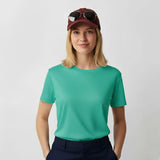
Finding the best quality T-shirts starts with knowing what to check. Whether you want a classic cotton crew-neck T-shirt, a lightweight everyday tee, or a more structured style, fabric, fit, and construction matter more than a “premium” label alone.
This guide explains how to choose a quality T-shirt, compare sizes when shopping online, and build an everyday wardrobe with white, black, and navy blue tees.
Choose an everyday T-shirt that suits your routine
Before comparing fabrics, decide how you will wear your T-shirt. A lightweight tee for layering has a different job from a structured T-shirt you wear on its own.
- For warm days: Look for a comfortable, breathable fabric and a fit that gives you room to move.
- For layering: Choose a smooth fabric and a crew neckline that works under your overshirt, sweater, or jacket.
- For wearing on its own: Check opacity, drape, and whether the neckline and sleeves keep the shape you prefer.
What to look for in cotton T-shirts
Check the actual fiber composition. “Cotton-rich” is not the same as 100% cotton, and a blend is not automatically better or worse. The right choice depends on the feel, stretch, and care you want.
Cotton is a familiar choice for everyday tees. Elastane can add stretch, while other fibers can change drying time, texture, and drape. When comparing premium cotton T-shirts, look for clear composition and sourcing information rather than treating a fabric name alone as proof of quality.
If you are comparing Supima cotton T-shirts with other cotton options, check the same practical details: fit, fabric weight, construction, and care instructions. The cotton variety is one part of the decision, not a substitute for the rest.
Fabric weight also affects how a T-shirt feels. If the product lists GSM, that means grams per square meter, a measure of fabric weight. Higher GSM usually means a heavier fabric, but heavier does not automatically mean better. A lighter tee may be exactly what you need for layering or hot weather.
How to spot quality T-shirt construction
When you can inspect a T-shirt in person, turn it inside out and look closely. When shopping online, use close-up photos or ask for them.
- Stitching: Look for even stitches without obvious gaps, loose threads, or puckering.
- Neckline: Check that the collar lies flat rather than looking stretched or wavy.
- Seams: Look for smooth joins that do not feel bulky or irritating against your skin.
- Hem: Check that it sits evenly and is not visibly twisted.
- Opacity: View the fabric in normal daylight if possible, especially when choosing a white T-shirt.
No single detail guarantees durability, but checking several together gives you a more useful picture than relying on a label or price tag.
Find the right T-shirt fit and size
Size labels vary between brands. Whether you are browsing men's T-shirts or women's T-shirts, measuring a tee that already fits you well can reduce guesswork.
- Lay your T-shirt flat without stretching the fabric.
- Measure the chest straight across, just below the armholes.
- Measure the length from the highest shoulder point to the bottom hem.
- Compare these measurements with the product’s size chart.
Check whether the chart shows body measurements or garment measurements. They are not interchangeable. If it is unclear, ask before ordering.
For a slim-fit T-shirt, check that the chest and shoulders do not pull when you move. For a relaxed-fit or oversized T-shirt, look for intentional room without a neckline that feels too wide or a length that gets in your way. Raise your arms and sit down during a try-on, not just while standing in front of a mirror.
White, black, or navy blue T-shirts: which should you choose?
You do not need every color. Start with the one that works with the clothes you already wear most.
- White T-shirts: A versatile option with denim and neutral trousers. Pay extra attention to opacity and the color of any layer underneath.
- Black T-shirts: Useful for a simple, tonal outfit or a sharper contrast with lighter trousers. Check the care label before washing.
- Navy blue T-shirts: An easy alternative to black that pairs well with beige, grey, white, and denim.
For your first purchase from a new brand, one well-chosen color lets you assess the fit and how the tee washes before adding more.
How to care for your cotton T-shirts
A T-shirt is only practical if its care requirements fit your routine. Read the garment’s own label first, particularly for washing temperature, drying, and ironing.
Do not assume every cotton tee can be washed or dried the same way. If shrinkage is a concern, look for specific information from the seller. “Pre-shrunk” should not be read as a promise of zero shrinkage.
After washing, compare the fit, neckline, and seams with how they looked before. Following the care label gives you a fairer way to judge how the garment performs over time.
What to check when buying T-shirts online
Before ordering, look for these practical details:
- Exact fiber composition.
- A clear T-shirt size chart and explanation of the fit.
- Close-up photos of the collar, fabric, and stitching.
- Care instructions.
- Reviews that discuss fit and wear, not just delivery.
- Clear return and exchange information.
If a detail matters to you and is missing, ask. A specific question such as “Does the size chart show the garment’s chest width?” is more useful than “Is this good quality?”
Your quality T-shirt buying checklist
- Does the fabric suit how and where I will wear it?
- Have I checked the composition rather than relying on marketing terms?
- Do the measurements match a T-shirt I already like?
- Can I see the neckline, seams, and fabric clearly?
- Will the care instructions work with my routine?
- Have I checked the return and exchange details?
The best T-shirt for you is not necessarily the heaviest or the most expensive. It is the one that fits comfortably, suits your everyday wardrobe, and performs well with the care you can realistically give it.
Ready to compare options? Explore NOO-BRAND’s Supima cotton T-shirts, and use this checklist to decide what works for you.